

Are you tired of AI-generated content that sounds robotic and lacks your personal touch?
As artificial intelligence continues to evolve, it’s becoming increasingly important to humanize AI content to make it sound more authentic and engaging.

In this article, we’ll explore three effective methods to clone your writing style and create AI content that truly sounds like you.
Key Takeaways
- Custom GPTs can be trained to mimic your writing style using your own content and specific instructions.
- Claude projects offer a user-friendly interface for customizing AI outputs to match your voice.
- AI tools like Cuppa provide comprehensive features for humanizing content at scale.
How to Humanize AI Content (Video)
The Importance of Humanizing AI Content
Before we dive into the methods, let’s understand why humanizing AI content is crucial. Google has stated that they reward high-quality content, regardless of how it’s produced.
This means that well-crafted AI-generated content has the potential to rank well in search results. However, it’s essential to avoid bulk-creating low-quality AI content, as this can lead to penalties.
The goal is to create AI-generated content that sounds natural, aligns with your brand voice, and provides value to your audience. Let’s explore three effective ways to achieve this.
How to Humanize AI Content (Three Methods)
Method 1: Using Custom GPTs to Clone Your Writing Style
Custom GPTs, available through ChatGPT Plus, offer a powerful way to humanize your AI content.

Here’s how to set up a custom GPT that mimics your writing style:
- Create a custom GPT with your name or brand.
- Edit the GPT and provide detailed instructions.
- Upload knowledge sources that reflect your writing style, such as:
- PDF version of your LinkedIn profile
- Self-written bio
- Transcriptions of your videos or podcasts
A crucial step in humanizing your content is to exclude words commonly used by AI models.
Instruct your custom GPT to avoid phrases like “delve,” “tapestry,” “vibrant landscape,” “realm,” “embark,” and other AI-sounding terms.
To refine your custom GPT:
- Continuously tweak instructions and add more knowledge.
- Test it by asking it to write content on various topics.
- Analyze the output and make adjustments as needed.
While custom GPTs are powerful, they do require a ChatGPT Plus subscription, which costs $20 per month.
Method 2: Leveraging Claude Projects for Customization
Claude projects, available through Claude Pro, offer an alternative to custom GPTs with a more user-friendly interface.
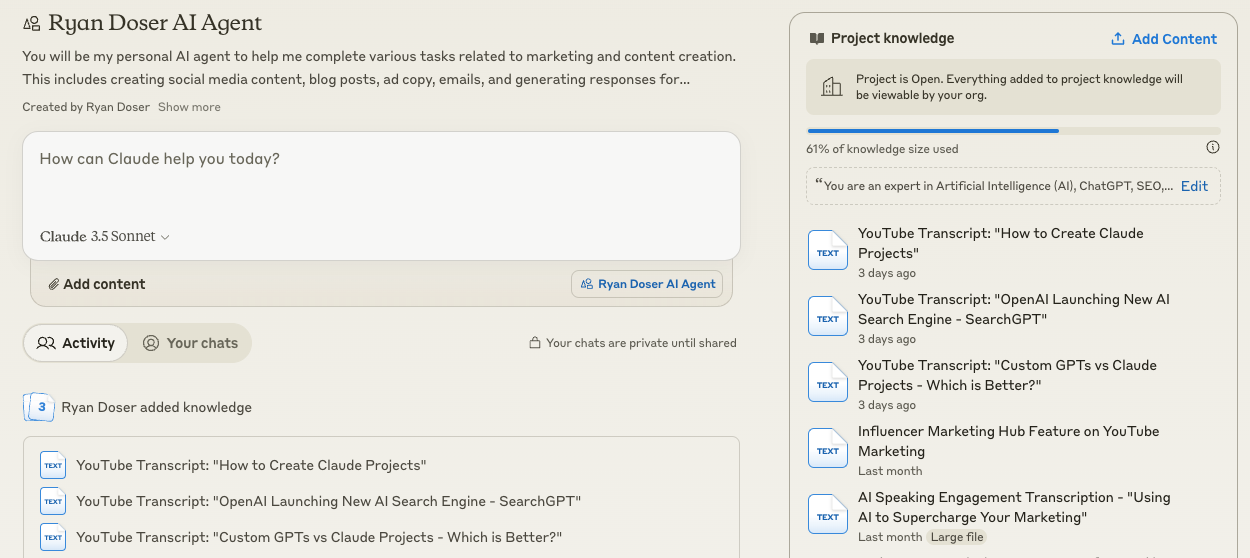
Here’s why Claude projects might be preferable for humanizing AI content:
- Easier customization of knowledge and instructions.
- Ability to add various types of content:
- LinkedIn profile
- Bio
- Podcast transcriptions
- Speaking engagement transcripts
- YouTube video transcripts
Similar to custom GPTs, you can provide custom instructions, including writing tone and words to avoid. Claude projects often produce content that sounds more human-like and may perform better on AI content detection tests.
To use Claude projects effectively:
- Continuously update your project knowledge with new content you create.
- Experiment with different types of prompts to see how well it mimics your style.
- Use the output for various content types, such as social media posts or blog articles.
Claude Pro also costs $20 per month, similar to ChatGPT Plus.
Method 3: Using Cuppa for Custom Presets
Cuppa is an all-in-one AI tool that offers a more affordable option at $13 per month. It provides several advantages for humanizing AI content.

Some of the benefits of using Cuppa include the following:
- Access to multiple AI models, including GPT and Claude.
- Custom presets for creating content at scale.
- Advanced customization options:
- Tone of voice settings
- Point of view instructions
- Content manipulation features
- Keyword integration
Cuppa’s content manipulation feature is particularly useful for humanizing AI content. It allows you to specify words to avoid and provide replacements, helping to eliminate AI-sounding language from your outputs.

To make the most of Cuppa:
- Create detailed custom presets for different content types or brands.
- Utilize the content manipulation feature to refine your AI-generated text.
- Experiment with different AI models to find the one that best mimics your style.
Which Method for Humanizing AI Content is Best?
Each of these methods has its strengths, and the best choice depends on your specific needs and budget:
- Custom GPTs are great if you’re already using ChatGPT Plus and want deep integration with OpenAI’s models.
- Claude projects offer a user-friendly interface and potentially more human-like outputs.
- Cuppa provides a comprehensive solution at a lower price point, with access to multiple AI models.
Regardless of the method you choose, the key to humanizing AI content is continuous refinement.
Keep updating your instructions, adding new knowledge, and analyzing the outputs to ensure they truly sound like you.
Conclusion
Humanizing AI content is essential for creating engaging, authentic material that resonates with your audience. By using custom GPTs, Claude projects, or tools like Cuppa, you can train AI to mimic your unique voice and style.
Remember, the goal is not just to bypass AI detectors but to create high-quality content that provides value to your readers while maintaining your personal touch.
FAQs
Can AI-generated content rank well on Google?
Yes, Google has stated that they reward high-quality content regardless of how it’s produced. Well-crafted AI-generated content has the potential to rank well if it provides value to users.
How much do these AI humanization tools cost?
ChatGPT Plus and Claude Pro both cost $20 per month, while Cuppa is more affordable at $13 per month.
Is it necessary to use all three methods to humanize AI content?
No, you don’t need to use all three methods. Choose the one that best fits your needs and budget. Many content creators find success with just one of these tools.
How often should I update my AI’s knowledge base?
It’s best to update your AI’s knowledge base regularly, ideally whenever you create new content or your writing style evolves. This ensures that the AI stays current with your latest work and style.
Can these methods completely eliminate the risk of content being detected as AI-generated?
While these methods significantly improve the human-like quality of AI-generated content, no method is foolproof. The goal is to create high-quality, valuable content rather than simply bypassing detectors.


